1- Jabal Ithlib
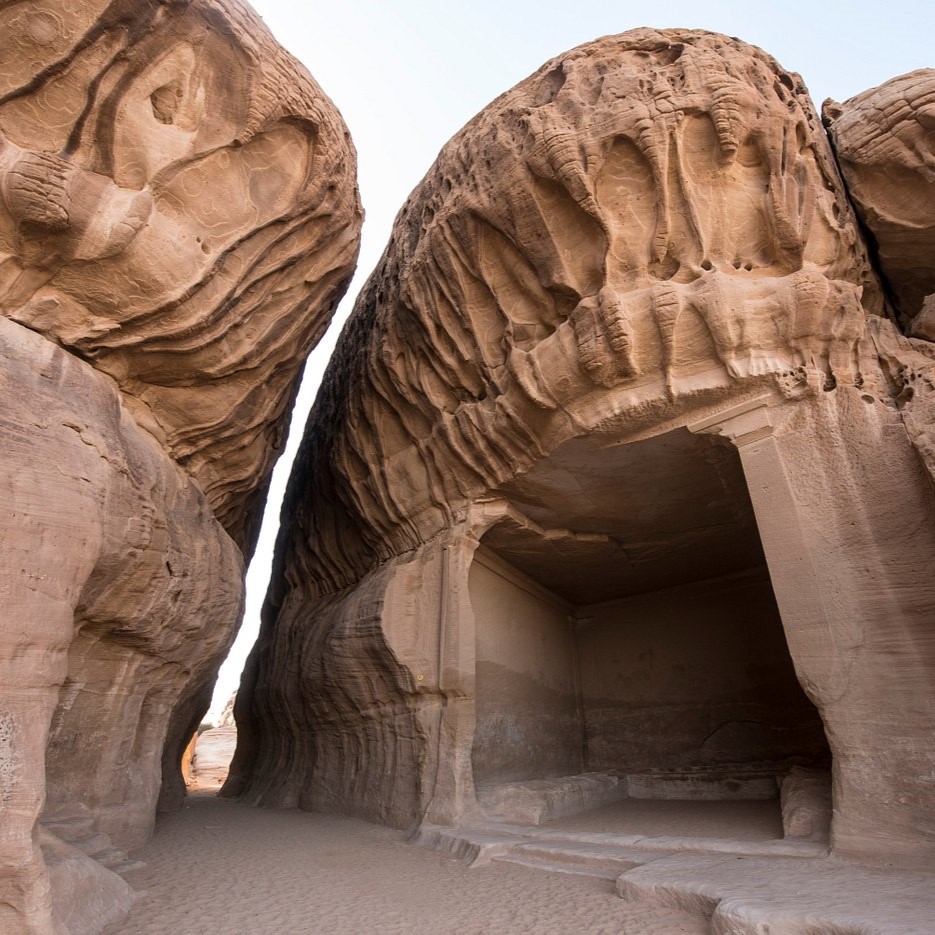
Located to the east of Al Ula, in the heart of Hegra, an archaeological site in Hejaz, Jabal Ithlib is a glorious, natural mountain and a cultural site. Historically, it was a place of worship for Nabateans who were ancient Arabian nomads from the Negev Desert.
The biggest attraction of Jabal Ithlib is the ‘Diwan’ which is a large room carved into the rocks of the mountain that looks like a dining area or a triclinium. It is historically believed to have been an important room for gatherings such as royal banquets and political meetings and also has an open front, which was probably designed for outside or public observers. Apart from that, the cultural roots and mind-blowing landscape of the mountains is what attracts tourists from all over the world.
The mountain can be accessed from a passage through the Siq canal which lies to the left of Diwan. Past this canal is the central area of the mountain that has many carvings and inscriptions that may have had something to do with ancient religious practices. There is also a water channel that flows through the center of the mountain range and leads into a natural water basin and eventually into a cistern. It is another site from which we can learn the lessons of the past.
2- Elephant-Rock (Jabal AlFil)
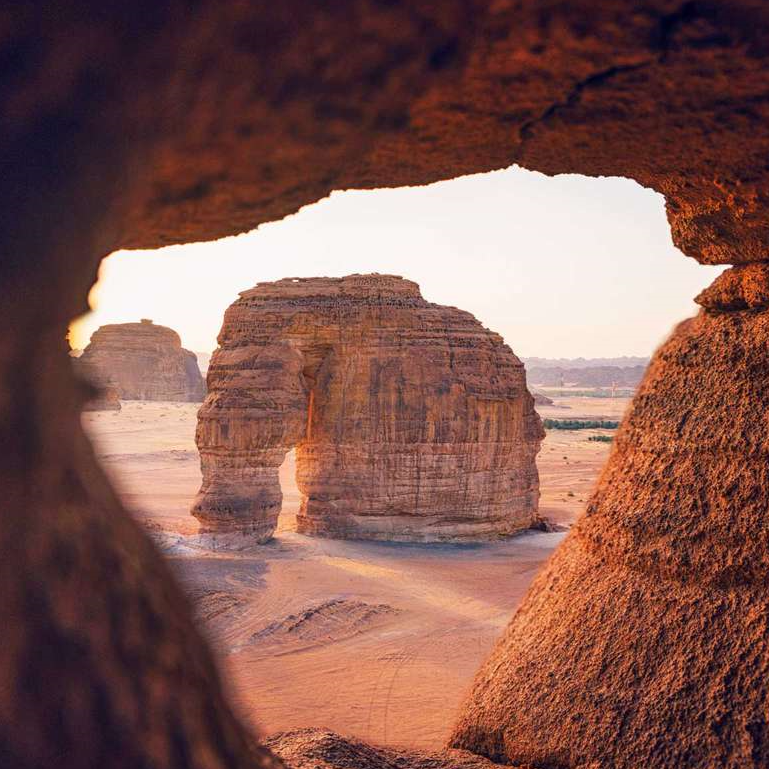
The Elephant Rock (Jabal AlFil) is one of the world’s most popular rocks formations and the highlight of the region of Al Ula, a city of the Madinah Province in Saudi Arabia. Looking at it from afar, this rocks seems like an elephant with a ground-bound trunk. The Elephant Rock is also known as Jabal-Al’fil in the Arabic language. Standing at a height of 52 meters, the giant rock climbs three stories into the Arabian sky. It is hard to look at the gargantuan Elephant Rock and not feel awestruck by its tremendous size.
The huge elephant stands in a landscape of golden sands, surrounded by other rocky formations which are equally impressive in size. Regardless, the Elephant Rock still overshadows all that falls in its sight and acts as reminder of the sands of time. The beauty of this mighty elephant only increases at nightfall where it becomes more lifelike in the warm lights that have been installed at the site. Visiting the rock at night is advantageous to avoid the hot weather during the day.
3- Hegra (Mada'in Saleh)
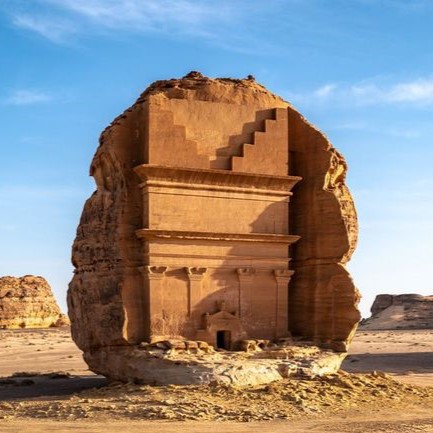
Hegra, or Mada'in Saleh, is an archaeological site located in Al Ula. Once home to an ancient civilization, the site was the kingdom's southernmost and largest settlement after Petra. Visitors can marvel at the remnants of the lost civilisation and natural beauty of the surrounding landscape.
Mada'in Saleh is famous for Prophet Saleh (Peace be upon him) and his camel. The people of Thamud lived in Hegra and carved houses inside the mountains, thinking themselves to be invincible. According to Muslim belief, Prophet Saleh was sent to these people to bring God's message. However, the people demanded a miracle, and so a camel came out of the mountains. The Prophet forbade the people to bother the camel, but they did not listen and ended up killing the poor creature. As a result, severe earthquakes destroyed the entire tribe. The land violently shook, destroying all living creatures in it.
4- Old town of Alula
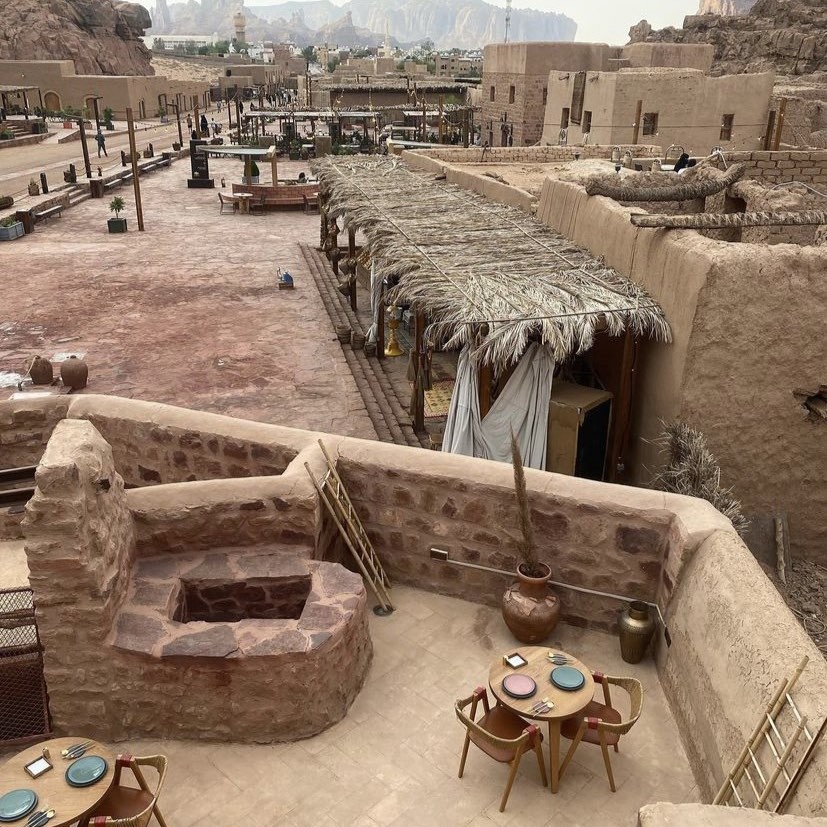
Al Ula - Old Town, also known as Deira, is an archaeological site near Al Ula in the Madina Province. It is one of the main attractions in Al-Ula as it consists of many ancient heritage buildings, mosques, and markets. All these ruins date back to about seven centuries, according to historians, and the town was inhabited up until the early 1980s.
Visiting the old town provides researchers and historians with a rich history of the town’s settlers and pilgrims and how they constructed the city. The buildings inside were once built with original stones and mud bricks. There are around 900 houses built closely together and separated only by narrow alleys. There is also a castle called the Al-Ula Castle that can be traced back to the 10th century. The top of the castle provides a panoramic view of Al-Ula and an opportunity to take amazing pictures. Tourists can also walk around one of the main plazas of the town, the Tantora Plaza, which is built around the Tantora sundial.